
Policy Paper: Georgia’s Fight for Democratic Survival
Georgia is on the path to authoritarian consolidation of power. The systematic restriction of civil society, political competition, and freedom of assembly goes hand in hand with a foreign policy shift away from the EU. An analysis by Nino Chachava and Saba Brachveli (both: Civil Society Foundation, Georgia).
Introduction
Georgia is undergoing a profound political transformation that can no longer be described as mere democratic backsliding. The ruling Georgian Dream (GD) party is accelerating a systemic consolidation of power, mirroring the trajectories of competitive authoritarian regimes. The pace and direction of recent developments indicate a structural shift toward a one-party autocratic system with increasingly totalitarian features. Core democratic pillars – civil society, political pluralism, independent institutions, freedom of expression, and freedom of assembly – are being systematically targeted.
This internal transformation is inseparable from Georgia’s foreign-policy reorientation. The adoption of Russian-style legislation not only provides tools for internal repression but also signals a deliberate geopolitical shift. As the government consolidates authoritarian power at home, it is simultaneously distancing itself from Georgia’s traditional Euro-Atlantic allies, escalating its confrontational rhetoric toward the EU and the United States, challenging long-standing partnerships, and, increasingly, echoing Kremlin narratives. These internal and external dynamics are mutually reinforcing, reflecting a strategic repositioning that aligns Georgia more closely with authoritarian models than with European democratic principles.
Yet despite sustained repression, Georgian society continues to resist in an unprecedented manner. Peaceful demonstrations have persisted without interruption for almost a year, with protesters, adapting to escalating police pressure, administrative detentions, and restrictive legislation. Civic activism continually finds new forms of expression, demonstrating both resilience and creativity in the face of authoritarian consolidation. Importantly, public backing for EU integration consistently exceeds 70 percent (Georgia annual survey 2025), and has thus been able to serve as one of the few remaining democratic stabilisers amid the country’s accelerating autocratisation.
Legal and coercive pressures on Georgian civil society
Over the past 2 years, the government has introduced and operationalised a series of legal, institutional, and coercive measures designed to suppress dissent and close down the remaining civic space. The current regression is structural rather than episodic and is driven by a deliberate and sustained effort to consolidate power through an increasingly restrictive legal framework reinforced by punitive enforcement practices.
Since 2024, civil society organisations (CSOs) have faced an unprecedented escalation of repression. This process began in spring 2024 with the adoption of the “Transparency of Foreign Influence” law and intensified further with the expanded “Foreign Agents” law and amendments to the “Law on Grants” in April 2025. Collectively, these measures have created a hostile operating environment that leaves virtually no space for independent civic activity.
Non-compliance with the Foreign Agents law results in criminal liability and severe financial penalties, while the amendments to the Law on Grants effectively prevent organisations from receiving foreign funding without prior government approval. Violations result in fines amounting to double the value of any unauthorised grant, undermining both the operational autonomy and the financial sustainability of the organisation in question. A recent PACE resolution 2624 (2025) describes the cumulative effect of these laws as devastating, emphasising that they place the very survival of Georgian civil society at immediate risk.
The authorities have accorded additional powers to the Anti-Corruption Bureau (ACB), granting it sweeping authority to access sensitive internal documents, communications, financial records, and data on beneficiaries. Since spring 2025, the ACB has carried out multiple waves of inspections of NGOs, ultimately encompassing approximately 100 organisations. These inspections are widely perceived as politically motivated and intended to induce institutional paralysis, discourage public engagement, and compel self-censorship.
Repression intensified sharply in August 2025, when authorities froze the bank accounts of seven CSOs as part of a criminal investigation. At issue is the suspected commission of several serious criminal offences including sabotage, attempted sabotage under aggravated circumstances, assisting a foreign organisation or an organisation under foreign influence in hostile activities, and financing actions against Georgia’s constitutional order and national security. These charges carry penalties ranging from seven years to fifteen years of imprisonment. Authorities claim that the organisations’ funds were used to supply basic protective items to peaceful protesters during the 2024 demonstrations, which were marked by widespread police violence, as well as to cover fines, provide free legal aid, and engage with international partners. Among others, the directors of several CSOs have been summoned for questioning, while opposition political leaders are already formally charged under similar allegations.
Amidst increasing pressure on civil society, the government has announced a controversial reform of higher education, involving changes to the funding of universities, the redistribution of faculties, and anoptimisation of resources. Concerns have emerged that, given the non-transparent and extremely expedited process and the climate of growing hostility toward dissent in academia, the reform may be aimed at establishing political control over universities and further eroding any remaining independent spaces within the academic sector.
Despite mounting pressures, including the risk of criminal prosecution, intrusive inspections, asset freezes, and persistent state-orchestrated defamation, Georgian CSOs continue to operate. Many have adapted by adjusting their strategies, decentralising their operations, and developing alternative methods and means to continue their work. However, these measures reflect established authoritarian techniques for constricting civic space, weakening democratic accountability, and eroding the institutional foundations essential for pluralistic governance. The trajectory indicates not merely backsliding but the systematic dismantling of the civic sector as an independent actor within Georgia’s state system.
Erosion of Political Pluralism in Georgia: Legal and Institutional Mechanisms
By 2025, the political environment in Georgia has deteriorated dramatically. State actions against opposition leaders reached levels incompatible with democratic governance and the rule of law. Seven leaders, representing all the major opposition parties, are in detention or have been convicted, with some serving several months in jail for non-compliance with summonses issued by a one-party parliamentary investigative commission, which is widely regarded as a partisan tool and lacking procedural legitimacy.
In November 2025, the Prosecutor’s Office brought new criminal charges against eight opposition leaders, including sabotage, collaboration with foreign powers, and attempting to overthrow the constitutional order. Opposition leaders now face the prospect of long-term imprisonment on charges for activities that clearly fall within the boundaries of legitimate political participation.
At the same time, the ruling party has been advancing legislative measures that directly threaten political pluralism. On 16 October 2025, the one-party parliament adopted, through an expedited procedure, a package of amendments enabling the prohibition of political parties and the indefinite deprivation of political rights for individuals associated with them. The intent and effect of these measures was to preemptively exclude the ruling party’s political competitors from participation in public life. The legislative changes were immediately followed by a constitutional appeal requesting the banning of three major opposition parties.
The legal justifications presented are broad and politically charged, including claims that opposition parties have questioned the legitimacy of the government, actions related to the 2008 August war, decisions to boycott elections.
On 17 November, the ruling party introduced further amendments to the Election Code, effectively depriving Georgian citizens residing abroad of their right to vote in parliamentary elections, claiming that these citizens are “subject to pressure from foreign governments”. This step constitutes yet another measure contributing to the consolidation of increasingly authoritarian governance, further weakening societal and political pluralism.
The combined use of criminal prosecutions, restrictive legislation, and constitutional litigation demonstrates a coordinated strategy to consolidate one-party dominance through judicial and administrative means. These developments consolidate authoritarian control, effectively eliminating the conditions for genuine political competition and pluralistic governance.
Targeting of freedom of assembly in Georgia
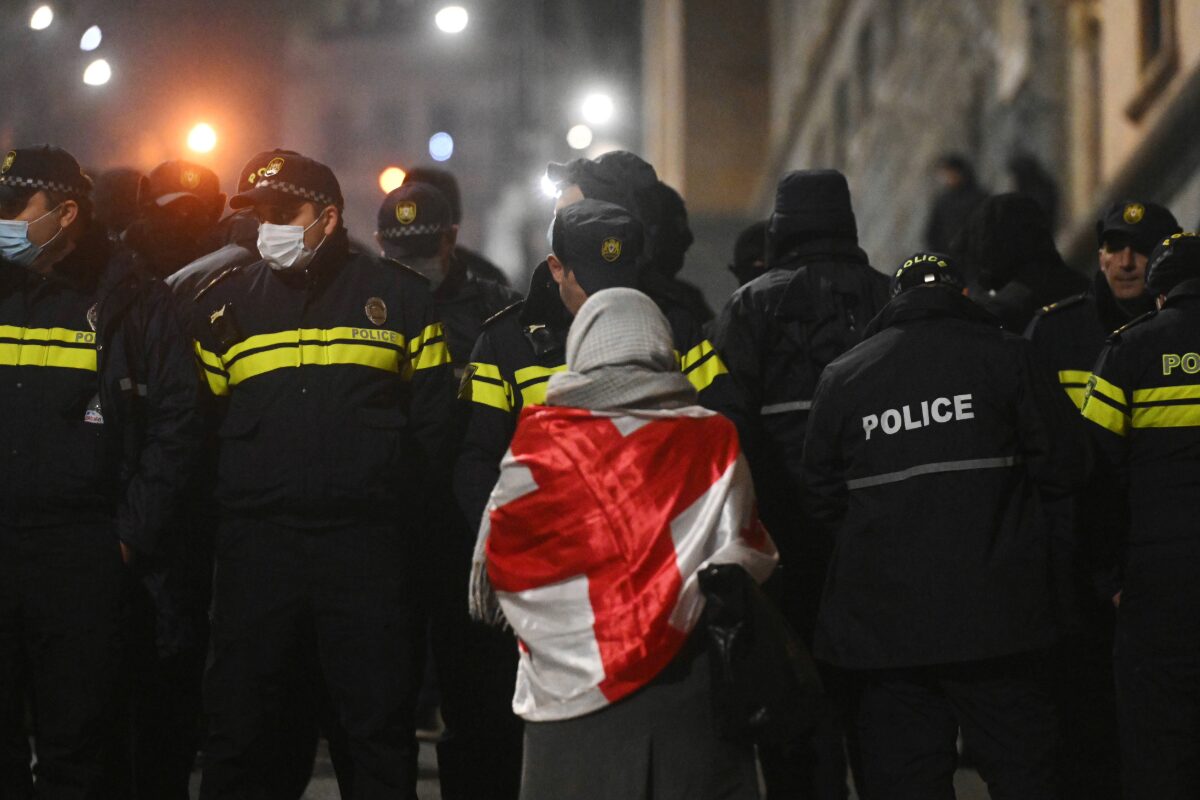
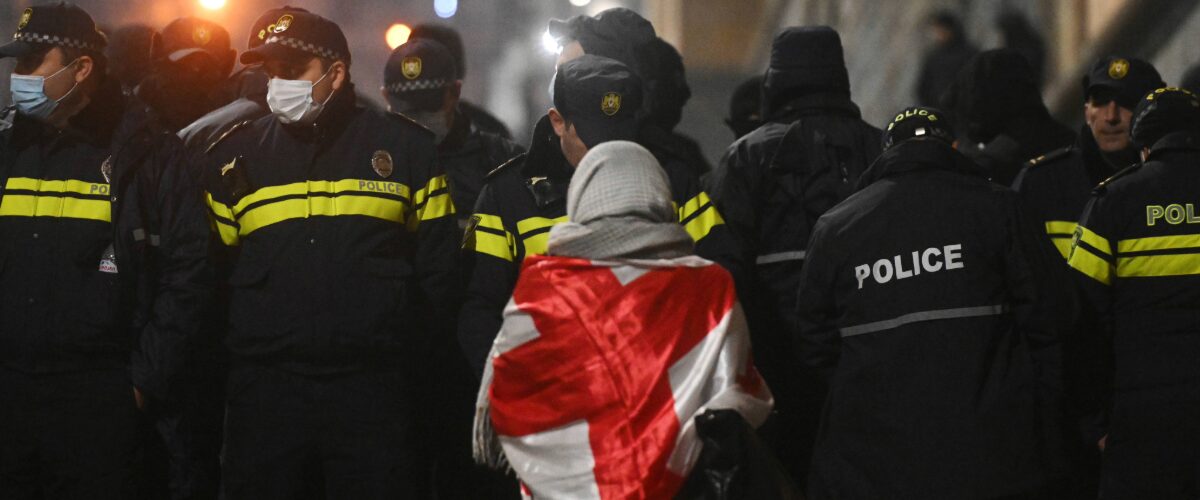
Since spring 2024, and especially during the November–December protests, Georgians have come under an escalating attack on freedom of assembly, with increasingly aggressive policing. Widespread abuse has been documented, including the unlawful and disproportionate use of special means resulting in serious injuries, arbitrary arrests conducted by unidentifiable police and special forces, physical violence during arrests, transport, and detention, denial of medical care and obstruction of emergency services, systemic impunity due to the failure of the Special Investigative Service and the judiciary to fulfill their mandates (Human Rights Crisis in Georgia [November 2024 – February 2025]: A Joint Report by Eleven Georgian Civil Society Organizations, Tbilisi, 14 May 2025)
On 1 December 2025, the BBC reported finding evidence suggesting that Georgian authorities may have used prohibited chemical substances against protesters during the demonstrations that started on 28 November 2024. If this did indeed occur, it would constitute a severe violation of international norms, human rights obligations, and Georgia’s commitments under international conventions.
Instead of providing transparency about the chemical agents used against peaceful protesters, the State Security Service of Georgia has begun summoning individuals featured in a BBC documentary, including doctors and human rights defenders, for questioning as part of an investigation into alleged “assistance to foreign entities” and “abuse of official powers.”
Although hundreds of cases of ill-treatment of demonstrators in November and December 2024 have been reported, none of the incidents has been investigated. Following the violent crackdowns, the international community responded by imposing targeted sanctions and travel bans on high-ranking police officials and judges, several of whom were dismissed later. After mid-December, large-scale physical violence declined, and the authorities appeared to shift their tactics from the widespread use of force to legal, administrative, and financial forms of pressure, a shift that may have been influenced, among other factors, by the sanctions and the prospect of further international action
Over the past year, legal framework and policing practicesfor peaceful assembly in Georgia has undergone successive waves of restrictive amendments, transforming participation in protests into a high-risk and heavily penalised activity. The process began in December 2024, with the most recent amendments adopted in October 2025. Each legislative package has responded directly to emerging protest tactics: fines for protest-related acts were raised 20 to 30 times, reaching 5,000 GEL — which is approximately 2.5 to 3 times the average monthly income, and thus effectively unaffordable for ordinary citizens. Funds which previously provided financial assistance to people fined during the ongoing anti-regime protests or dismissed from their jobs due to their civic activism have also been frozen. The widespread imposition of these heavy fines has placed a disproportionate financial burden on participants, producing a chilling effect on the exercise of the right to peaceful assembly.
The maximum period of administrative detention has been extended from 15 to 60 days, thus surpassing comparable limits in Russia and Belarus (15 days). The October 2025, new amendments introduced administrative detention for first-time violations of assembly rules and criminal liability for repeat offences. The first case under the new rules has already been initiated. Under this new framework, even failure to comply with a lawful order from law enforcement can result in criminal charges and imprisonment. Fines have largely been replaced by detention, meaning that participants may now face up to 15 days of imprisonment for actions such as covering their faces during a protest, partially or fully blocking roads, or creating obstacles to pedestrian or vehicle movement.
Following the introduction of the new amendments, 5 to 10 people were detained daily for acts such as obstructing traffic. Police began physically preventing road-blocking, prompting protesters to shift from static rallies to mobile marches. Despite these adaptations, systematic arbitrary arrests continued, often targeting individuals simply for walking in groups or standing on sidewalks, and frequently based on absurd or fabricated accusations, including alleged disobedience to police orders. In October 2025, Transparency International Georgia documented the detention of eleven media representatives under administrative charges.
On December 10, new restrictive measures emerged, further tightening control over freedom of assembly. The amendments significantly expand state oversight by requiring organizers to notify the Ministry of Internal Affairs five days in advance of any gathering or demonstration and by extending assembly restrictions from roadways to pedestrian zones, effectively leaving practically no space for protest. Non-compliance can result in administrative detention of up to 15 days, while repeat offences carry criminal liability, including imprisonment for up to one year.
As regards criminal charges related to protest participation, Transparency International Georgia reports that 148 individuals have faced criminal proceedings since late 2024; 66 remain in pre-trial detention, and 54 have been convicted. In per capita terms, the number of criminalised protesters in Georgia now exceeds comparable figures for Russia, reflecting an extremely high level of repression in a country that nominally remains an EU candidate state.
The cumulative effect of excessive fines, routine administrative detention, and criminal liability for repeated offences has created a legal and policing system explicitly designed to eliminate civic mobilisation. By continuously tightening rules and adapting enforcement to protest tactics, the authorities are not merely responding to dissent, they are actively suppressing peaceful assembly and dismantling one of the final avenues for democratic expression.
Propaganda as a pillar of emerging autocracy in Georgia
A central pillar of the authoritarian consolidation is the ruling party’s expanding disinformation and propaganda system, which has become one of the most powerful tools for manipulating public opinion. GD-affiliated media outlets operate in close alignment with Kremlin narratives, systematically demonising and delegitimising international partners, EU institutions, and democratic allies. Critical statements from the EU, US, OSCE, and other organisations are portrayed as “foreign interference”, while domestic critics are framed as “enemies”, “traitors”, or agents acting against Georgian statehood. This narrative architecture not only seeks to isolate Georgia from its democratic partners but also creates a hostile environment in which violence and intolerance toward dissent are implicitly encouraged. By engineering an “information siege,” the ruling party reinforces public mistrust in independent voices and strengthens the ideological foundations of its emerging autocratic system.
Policy recommendations: coordinated international response to the consolidation of autocracy in Georgia
Georgia’s democratic future is still visible, provided those defending it receive the support and protection they need. A coordinated international strategy is required to uphold human rights, support civic space, and prevent further authoritarian consolidation in Georgia. Active engagement from the EU and other partner states could make a tangible difference. Specifically, the EU and other partner states could:
- Actively support an independent international inquiry
The recent BBC investigation into the alleged use of chemical irritants and unidentified substances against protesters has heightened concerns about systematic and escalating state violence in Georgia. Opposition parties and civil society organisations have already called for an independent international inquiry, led by credible organisations, to establish the facts, determine responsibility, and prevent further use of such substances. Supporting such an inquiry should be the initial step, providing a solid evidentiary foundation for any subsequent policy actions.
- Activate international human rights mechanisms
The activation of existing international human-rights accountability mechanisms is essential. The OSCE Moscow Mechanism, which has been used effectively in contexts such as Belarus, is a credible and rapid tool for use in cases where national institutions fail to ensure accountability. A fact-finding mission under this mechanism would be able to gather credible documentation of human rights violations on the ground. A report to that effect would create a solid ground for evidence-based, targeted international measures.
- Implement coordinated restrictive measures
Although it may be difficult to arrive at EU-wide unanimity, individual member states can still act in concert with one another to impose targeted sanctions on individuals and entities responsible for repression. Bilateral or coalition-based measures, such as through a Weimar+ format (Germany, France, Poland and like-minded partners), can reinforce the legitimacy of evidence, ensure accountability despite EU-level gridlock, and impose tangible consequences on actors driving democratic backsliding. Credible documentation from international investigations or OSCE fact-finding missions would form the basis for such targeted measures, aligned with the EU Global Human Rights Sanctions Regime (Council Regulation 2020/1998).
- Apply financial pressure on authoritarian networks
Targeted financial measures would be a highly effective tool with which to influence the autocratic leadership. Measures restricting access to assets, financial networks, and operations controlled by oligarchic structures, as well as by pro-government businesses and media outlets, would be particularly effective. Such steps would weaken the regime’s resource base, disrupt its propaganda networks, limit its capacity for repression, and strengthen independent actors and civil society. Implementation can be bilateral or coordinated, depending on legislative possibilities.
- Ensure civil society’s survival and resilience
External pressure should be accompanied by robust support for civil society actors, including flexible, rapid-response funding, emergency assistance for activists and independent media, continued legal aid for detainees and victims of repression, and measures aimed at protecting journalists, human-rights defenders, and civic activists. Strengthening civil society in this way is essential to maintaining channels for peaceful mobilisation and protecting fundamental rights under increasing state pressure.
- Rethink EU democratic leverage in emerging autocracies
As Georgia’s leadership has effectively suspended the country’s EU accession, the scope for the Union to apply its core pre-accession tool of conditionality is significantly reduced. This underscores the inadequacy of existing EU instruments to address autocratic regimes that renounce EU integration in order to diminish the Union’s democratising leverage. The situation in Georgia, therefore, necessitates more serious reflection, a thorough assessment of the realities, and the development of a more strategic and adaptable approach capable of responding to contexts where an authoritarian turn makes current EU democracy-promotion policies ineffective.
Authors:
Nino Chachava (EU- Projectcoordinator, Civil Society Foundation, Georgia) and Saba Bachveli (Human Rights Program Manager, Civil Society Foundation, Georgia)

Hat Ihnen unser Beitrag gefallen? Dann spenden Sie doch einfach und bequem über unser Spendentool. Sie unterstützen damit die publizistische Arbeit von LibMod.
Spenden mit Bankeinzug
Spenden mit PayPal
Wir sind als gemeinnützig anerkannt, entsprechend sind Spenden steuerlich absetzbar. Für eine Spendenbescheinigung (nötig bei einem Betrag über 200 EUR), senden Sie Ihre Adressdaten bitte an finanzen@libmod.de