
Hungary swings back to Europe – and what this means for its partners

Hungary’s parliamentary elections of 12 April marked a clear end to the 16-year rule of Prime Minister Viktor Orbán and his Fidesz party, a period that will be recorded as the first attempt to establish an illiberal, semi-authoritarian regime within the European Union. Daniel Hegedüs, Deputy Director at the Institute for European Politics (IEP), analyzes what Péter Magyar’s victory means for Europe.
Orbán’s time in office was characterized by the systematic dismantling of democratic institutions and checks and balances, the entrenchment of politically organized and strategic corruption, and a reorientation of Hungary’s geopolitical alignment away from its European partners toward Europe’s strategic challengers, including the authoritarian great powers Russia and China, and – since January 2025 – increasingly the Trump administration.
Together with the erosion of output legitimacy and the regime’s persistently weakening economic performance, these three factors played a decisive role on the demand side of politics in driving the robust mobilization of Hungarian society in support of governmental and regime change. On the supply side, the notable political achievements of the “Respect and Freedom” (Tisza) party – established in early 2024 – and its leader, Péter Magyar, increasingly convinced Hungarian voters of the plausibility of opposition victory and political transformation. This encompassed not only the successful development of party structures and a resilient political movement in rural areas beyond the traditional urban strongholds of the opposition, but also the articulation of compelling narratives that effectively linked the regime’s corrupt practices to the everyday “bread-and-butter” concerns of ordinary citizens.
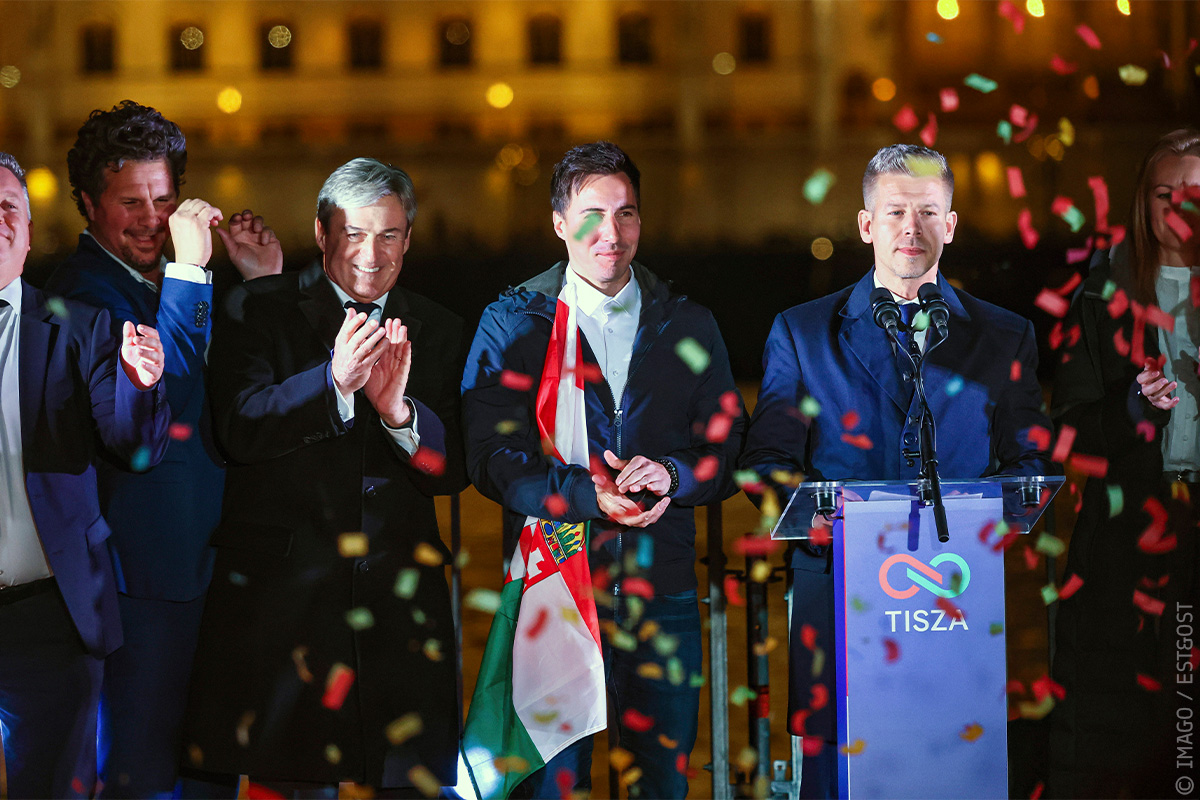
This political configuration resulted, on 12 April, in a historic record turnout of 79.56 percent and a constitutional supermajority of 141 mandates (out of 199) for Tisza. While approximately 70 percent of parliamentary seats was secured with only 53.18 percent of the party-list vote, it is important to emphasize that Tisza achieved this landslide victory within the same electoral system designed by Fidesz – one that had previously enabled Fidesz to obtain constitutional supermajorities with similar or smaller shares of the popular vote. Moreover, the opposition’s victory was delivered in a “free but not fair” election, conducted on an uneven playing field that conferred structural advantages on the incumbent Fidesz party.
Restoring democracy, combating corruption, and re-establishing Hungary as a constructive partner within the European Union constitute the most important tasks facing the new government. However, while the regime of Prime Minister Orbán represented a well-known quantity in Europe, the incoming prime minister, Péter Magyar, and his government are understandably less familiar, creating space for a wide range of projections among investors and international partners. Against this backdrop, it is worth examining the key reform challenges in both the domestic and European political arenas, as well as the expectations surrounding Hungary’s newly elected democratic government.
The Way out of State Capture
Over its 16 years in power, the Orbán regime established political control over all key constitutional institutions as well as Hungary’s media system. This control – particularly over the Prosecutor’s Office and the judiciary – enabled regime actors to become deeply entangled in political corruption without facing prosecution or consequences under criminal law. As a result, the restoration of the rule of law and the fight against corruption are likely to be closely intertwined in the months and years ahead in Hungary.
Even though the new parliamentary majority holds a constitutional supermajority, the process of restoring the independence of state institutions will most likely take years and may closely resemble the post-2010 period of constitutional engineering carried out by Fidesz – albeit directed toward the re-establishment of democratic checks and balances.
In his victory speech on the evening of 12 April, Péter Magyar called for the resignation of Hungary’s president, as well as the heads of several key institutions, including the Constitutional Court, the Supreme Court (Kúria), the Prosecutor General’s Office, and the State Audit Office, among others. This reflected not only the recognition that these political appointees have come to symbolize state capture in Hungary, but also the understanding that the independent functioning of these institutions is scarcely conceivable with their current leadership in place. Since then, Magyar has used several public appearances to sustain pressure on these officials, tacitly acknowledging that their removal from office is difficult – if not impossible – under the existing constitutional framework.
Tisza holds the political capacity to comprehensively overhaul the Hungarian state system – including its officeholders – through the adoption of a new constitution. However, such a course of action could be perceived as controversial, both domestically and at the level of the European Union. Péter Magyar has stated that he will not pursue a new constitution without the consent of other political parties. Should he adhere to this commitment, his government will be limited to constitutional amendments and a gradual dismantling of state capture – an approach that will require the careful identification of entry points, a methodical strategy, and time.
In certain areas, however, results may be delivered rapidly. Tisza is likely to defund and restructure Hungary’s Fidesz-controlled public broadcasters, accede to the European Public Prosecutor’s Office, and, leveraging its constitutional majority, swiftly establish an Anti-Corruption Prosecutor’s Office similar to those operating in Romania and Ukraine. By contrast, the implementation of other reforms may proceed more slowly; greater clarity in this regard is expected to emerge from the new government’s program.
EU and Foreign Policy Impact
While Hungary’s domestic autocratization has posed a significant challenge to the democratic integrity of the European Union – as has its record of strategic corruption affecting the EU’s financial interests – since Russia’s full-scale invasion of Ukraine in February 2022, Budapest has been primarily perceived as a spoiler due to its obstruction of key EU decisions. Since 2022, the Orbán regime has blocked all major financial assistance packages and instruments designed to support Ukraine at the EU level, and has diluted or delayed most of the EU’s 20 sanctions packages against Russia.
In this regard, the new government may deliver an almost immediate breakthrough. On Monday, 13 April, Péter Magyar announced that his government considers the current €90 billion financial package for Ukraine a settled matter; given Hungary’s opt-out from the joint borrowing component, he sees no reason why its implementation should not proceed. In a similar vein, he at first indicated that Hungary will not raise objections to the launch of EU-Ukraine accession negotiations under the “Fundamentals” cluster.
In early May, Magyar’s position shifted: he linked lifting Hungary’s blockade on the launch of accession negotiations to a far-reaching expansion of the rights of the Hungarian minority in Ukraine. At the same time, he offered President Zelensky a bilateral meeting and signaled his willingness to reset relations between Kyiv and Budapest. Whether this renewed blocking stance on Magyar’s part is a negotiating strategy aimed at securing maximum concessions on minority rights, or a revival of Fidesz-style coercive diplomacy, remains to be seen. However, the rapid shift in tone and course regarding the start of accession negotiations can be seen as an initial warning sign.
Another key EU-related issue for the new government will be the release of frozen EU funding. While successful anti-corruption reforms may unlock access to a significant share of the approximately €9 billion in suspended cohesion funds, the more critical question concerns the fate of the €4.9 billion allocated under the European Recovery and Resilience Facility (RRF), which is set to be entirely lost by August 2026 due to the expiry of the program. While some of these resources could be utilized through technocratic workarounds – such as channeling funds into financial instruments or investment vehicles – the prospects of preserving even part of this allocation to support Hungary’s post-illiberal reconstruction appear very limited in the absence of a political solution, notably in the form of a deadline extension.
Securing access to frozen EU funding will be critical both for the new government’s output legitimacy and for ensuring fiscal stability and sustainable economic growth in the years ahead.
The Investor Perspective
Hungary’s politically influenced and corruption-prone public procurement practices, discriminatory tax legislation, and the aggressive conduct of authorities toward politically disfavored companies have generated significant distortions in the domestic market.
A return to market-based principles, the rollback of preferential treatment, the introduction of robust anti-corruption measures, and the restoration of the rule of law could reposition Hungary as a more attractive investment destination within the European Union – not only for top-tier multinationals with established political connections, but also for mid-sized, internationally active companies. This shift may be further supported by increased domestic consumption and investment, driven by a renewed inflow of EU funds, as well as by the new government’s long-term commitment to adopting the euro.
While key elements of the new government’s tax, economic, and fiscal policies will only become clear with the publication of its program, investors can reasonably anticipate a more neutral, market-oriented, and business-friendly environment in Hungary – one in which the rule of law, rather than political connections and corruption, shapes economic outcomes.

Hat Ihnen dieser Artikel gefallen? Wenn ja, können Sie die unabhängige redaktionelle Arbeit und den Journalismus von LibMod über ein einfaches Spendentool unterstützen.
Spenden über PayPal

Wir sind als gemeinnützige Organisation anerkannt, dementsprechend sind Spenden steuerlich absetzbar. Für eine Spendenbescheinigung (ab einem Betrag von 200 EUR erforderlich) senden Sie bitte Ihre Adressdaten an finanzen@libmod.de