
Policy Paper: Georgia’s Soon-To-Be Dictatorship and What Can Still Be Done
This policy paper was written by authors who wish to remain anonymous
Georgia is at a critical political turning point. As the government increases pressure on civil society, experts warn of growing authoritarian tendencies and call for a more decisive response from Europe.
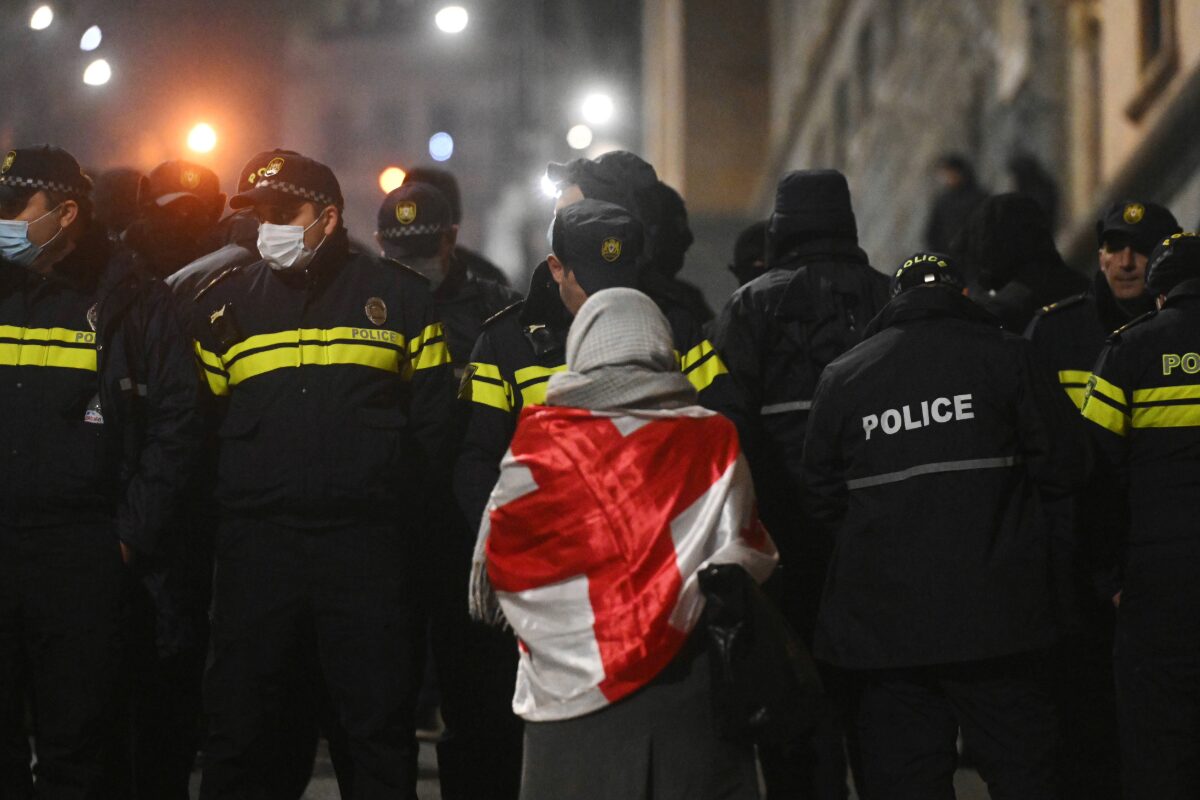
The EU candidate country is facing one of its deepest political crises in recent years. For more than a year, people have been taking to the streets in peaceful protest. At the same time, the Russia-leaning ruling party, Georgian Dream, has been hardening its course: repression against civil society, independent media, and the opposition is visibly intensifying.
Against this backdrop, leading representatives from Georgian civil society, academia, media, and politics travelled to Berlin at the invitation of the Center for Liberal Modernity (LibMod). During their visit, they took part in a press breakfast, a hearing in the Committee on European Union Affairs of the German Bundestag, and meetings in both the Bundestag and the Federal Foreign Office, where they also presented the following policy paper.
Executive Summary
Georgia is on the verge of consolidating a one-party dictatorship after more than a decade of rule by Georgian Dream, a party that has shifted from a nominally pro-European force to an openly authoritarian regime aligned with Russian strategic interests. Since 2023, democratic backsliding has accelerated dramatically through the adoption of repressive legislation targeting civil society, independent media, political opposition, and public protest. The latest legal package from March 2026 further shrinks the space for independent actors. The consensus on the nature of the Georgian Dream’s government, however, is widening internationally. The sanctions by the UK on propaganda media in February 2026 and the OSCE Moscow Mechanism report on the violation of human rights in March 2026, are the two latest developments, which demonstrate the potential of the external pressure mechanisms.
The internal authoritarian consolidation of Georgia is inseparable from a broader geopolitical shift. The Georgian Dream has frozen EU accession efforts, adopted anti-Western rhetoric, and increasingly mirrors Kremlin narratives, while advancing policies that objectively serve Russian interests. Yet, Georgia is not yet a lost cause. Despite sustained repression, opposition parties, civil society, independent media, and a strongly pro-European public continue to resist. Public support for EU integration remains above 70%, and mass protests demonstrate that the regime has not succeeded in reshaping societal preferences.
The central analytical mistake in some Western circles is to view Georgia as already irreversibly captured by Russia. This misdiagnosis risks strategic disengagement. The primary driver of authoritarianism in Georgia is not Russian control but the domestic logic of regime survival: a ruling elite unwilling to relinquish power and therefore systematically dismantling democratic pluralism. External engagement still matters because Georgia remains deeply dependent on Western economic, financial, and political ties.
A more effective Western response requires moving beyond fragmented and reactive measures toward a coordinated strategy of deterrence and support. Sanctions should be embedded in a broader framework of clearly communicated red lines and consequences, combined with incentives for de-escalation. At the same time, the West must prioritise the survival of democratic infrastructure (civil society, media, and political actors), whether inside the country or in exile. The window for action is rapidly closing, but Western leverage remains significant. The decisive question is whether it will be used with sufficient clarity, coordination, and resolve.
Introduction
In 2026, Georgia entered its fourteenth year of rule by the Georgian Dream (GD) party, which once positioned itself as a pro-Western political force committed to EU-oriented reforms and democratic transformation. Little more than a decade ago, Georgia was widely regarded as a frontrunner in post-Soviet democratisation and as a committed aspirant to EU and NATO membership. Today, it can be described as a country just five minutes away from a one-party dictatorship.
In recent years, Georgia’s progress along the trajectory from being a reform-oriented young democracy towards a system characterised by increasingly formalised authoritarian practices has accelerated. The rollback of reforms and the adoption of repressive legislation have been accompanied by a deliberate shift in foreign policy away from the country’s Euro-Atlantic partners. The country’s political environment increasingly resembles a totalitarian system: opposition political parties are soon to be banned; opposition leaders and activists face arrest, prosecution, or exile; civil society and independent media are under permanent legal and financial pressure; party loyalists have captured courts and security institutions; and nominally independent state bodies are subject to partisan and political control. The Georgian Dream also engages in internal political and administrative purges, a feature typical of authoritarian regimes.
In Georgia, as in many other states of the region, democratic decline has led to a shift in foreign policy. Foreign policy goals have shaped the state’s internal political trajectory since Georgia regained its independence in 1991, with European integration serving as the main structural anchor for democratic reforms, at least since 2003. Thus the current retreat from democratic transformation and the shift in foreign policy orientation are two interrelated dimensions of the same political process.
Consolidation of One-Party Dictatorship
Authoritarian consolidation in Georgia has become more visible since 2023, due to legislation targeting “foreign influence”, which restricts civic space and foreign funding. By centralising control over civil society, the media, and international assistance, Georgian Dream has sought to neutralise independent actors and limit foreign partners’ engagement, a pattern observed in other autocracies.
A series of legislative measures adopted since 2024 has systematically targeted freedom of assembly and expression, political parties, media, and, most recently, universities. Large parts of this framework are modelled directly on legal mechanisms used in the Russian governance model.
While democratic setbacks are not uncommon in young democracies, Georgia’s case reflects a sustained, accelerating shift toward a one-party rule closely aligned with Russian strategic interests. Importantly, dictatorship is not yet a fait accompli, but the coming months will be used to complete the process through a variety of means: the intensification of prosecutions, exerting financial pressure on independent media through selective funding, advertising restrictions, and regulatory fines, the widening of investigations against civil society, the arrest of civil society leaders, pressure on activists to leave the country, the arrest of the political opponents, and the finalisation of measures to ban major opposition parties.
Key Features of Georgia’s Autocratic System
There are clear similarities between Georgia’s regime and other authoritarian systems, but several features make the Georgian case distinctive:
- Informal rule: Bidzina Ivanishvili exercises de facto control over the state, despite holding no formal government office. This creates great challenges in terms of accountability and limits external leverage on him due to the lack of access and his informal capacity.
- Rapid authoritarian consolidation: Georgia has nearly completed its transition from a functioning, EU-oriented democracy to a formalised autocratic system in an unusually short period. What took other states a decade has been achieved by the Georgian Dream in less than two years.
- Russian alignment: The Georgian Dream government is functionally in unison with Russian strategic interests.
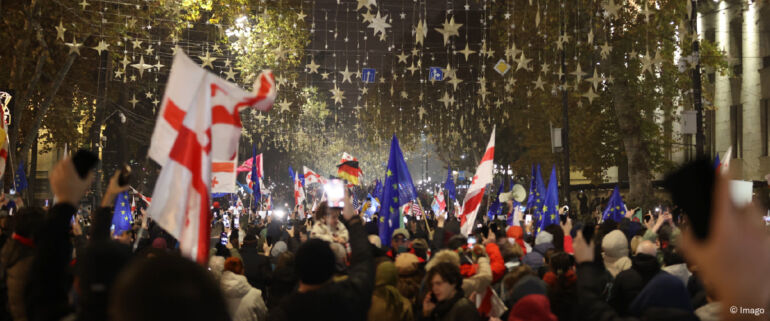
- Persistent societal resistance: Almost 500 days of street protests are evidence of a strong pushback from the public.
- Resilient democratic actors: Civil society, independent media, academia, and opposition parties continue to defend democratic space despite severe pressure.
- Enduring pro-European support: Public backing for European integration remains overwhelmingly high, consistently exceeding 70%, highlighting the tension between authoritarian consolidation and the population’s European orientation.
Latest Major Blow to Civil Society and Political Activism
On 4 March 2026, Georgian Dream adopted a new legislative framework, in addition to the existing Transparency of Foreign Influence Law, the Foreign Agents Registration Act (FARA), and the Law on Grants. The new legislative package is poised to deal a potentially fatal blow to civil society, independent media, and political activism.
Broad definition of grants: The legislation dramatically broadens the definition of a grant. The term grant now encompasses any transfer of foreign funds, monetary or in-kind, that may be used (read: interpreted) in the belief or with the intent of influencing government institutions, public policy, or any part of society. This includes activities related to shaping or changing domestic or foreign policy, as well as initiatives connected to the public or political interests of foreign governments or political actors. This effectively means that no media products, public policy analyses, public posts, or other output from think tanks or civil society can be produced by anyone who receives any foreign funding for any (even unrelated) purpose.
Thus, the law now equates funds associated with service contracts, donations, and technical assistance with grants. Transfers involving knowledge, expertise, technology, or professional services are automatically categorised as grants if they fall within the expansive political definition. This eliminates the previously existing distinction between project-based grants and contractual service arrangements, thereby including an entire range of legitimate professional and academic cooperation in its scope. In short, the GD is casting an all-encompassing net over any activities that they may decide to consider “political”, threatening to criminalise them if they are in any way linked to a foreign financial source.
Mandatory prior government approval: All such “grants” (read: transferred sums) require the prior approval of the Government of Georgia – effectively that of the State Audit Office, which is staffed by prosecutors and headed by the predecessor of the current prosecutor general. This requirement applies not only to domestic organisations but also to branches or representative offices of foreign legal entities (such as German foundations) operating in Georgia. Even funding transferred internally within an international organisation’s structure triggers the obligation to obtain approval. This law prohibits all cross-country cooperation on matters of policy and political activities concerning Georgia. Organisations must either submit their activities for political vetting or risk severe sanctions. The absence of clear procedural guarantees and objective criteria for approval further exacerbates the risk of arbitrary or politically motivated decisions.
Criminal liability: The most consequential aspect of the amendments is the replacement of administrative liability with criminal liability – imprisonment of up to 6 years. Engaging in grant-related activities without prior authorisation may result in fines, community service, or up to 6 years’ imprisonment. This reclassification elevates violations to the category of serious crimes, enabling the use of intrusive investigative techniques such as searches, seizures, and covert surveillance. By criminalising what was previously a regulatory offense, the legislation introduces a powerful chilling effect. Civil society actors, donors, and individual experts face the prospect of prosecution, asset freezes, and long-term imprisonment for engaging in activities that are recognised internationally as legitimate forms of civic participation.
Retroactive implications: The amendments include a clause requiring entities that previously received grants which were not subject to approval at the time to apply for retroactive approval within 1 month of the law’s entry into force. During this period, the use of received funds of this kind is prohibited. This retroactive application undermines legal certainty and places organisations in an impossible position: previously lawful agreements may suddenly expose them to criminal liability.
Impact on donors and international organisations: These amendments impose liability not only on recipients but also on donors and other funding providers. Employees of foreign organisations may face criminal consequences if they engage in funding activity that has not been approved. This creates significant operational uncertainty for international donors, including multilateral institutions and development agencies. To mitigate risks, donors may be forced to withdraw, reduce their level of engagement, or resort to opaque intermediary mechanisms. Such outcomes would undermine long-standing partnerships supporting legal aid, investigative journalism, election monitoring, and social services. The new restrictions are also in clear violation of Georgia’s obligations under the EU-Georgia Association Agreement.
Restrictions on political participation: The legislative package contains provisions whose scope extends beyond civil society to include political actors. Senior officials of political parties may face criminal liability for accepting foreign funding. Individuals employed by organisations that receive more than 20 percent of their annual income from foreign sources are prohibited from party membership for the next eight years. These provisions erect the wall between civic engagement and partisan activity, effectively disqualifying a significant segment of active citizens from participating in politics.
Impact on business and entrepreneurs: A new administrative offense introduced into the Code of Administrative Offenses applies to business enterprises that engage in public political activities unrelated to their core business activity. The sanction in this case is an administrative fine of 20,000 GEL (around 7,000 EUR), and repeated violations result in criminal liability, effectively barring a business from supporting civil movements and initiatives.
Criminalisation of “non-recognition” of constitutional bodies: amendments to the Criminal Code introduced penalties for “systematic and public” calls to defy government bodies, create alternative authorities, or question the legitimacy of the constitutional order. Sanctions include fines, community service, or up to three years’ imprisonment. Moreover, “non-recognition” of this kind as a motivating factor will also serve as an aggravating circumstance for other offenses that can result in a longer sentence. The vague and expansive wording grants the authorities broad discretion, raising concerns that ordinary political speech – including references to the ruling party as a “regime” or refusal to acknowledge officials as legitimate – could be treated as criminal conduct.
New Restrictions on Assemblies: Criminalising Pavement Protests
In late December 2025, the Georgian Parliament passed another set of amendments to the Law on Assemblies and Manifestations and to the Administrative Offences Code, which further tightened restrictions on public protests. The amendments expand the scope of prohibited conduct to include “obstructing people’s movement” in pedestrian areas, including pavements (sidewalks), whereas previously only the blocking of roads was punishable. This change transformed even non-disruptive protest tactics, such as standing or chanting on a pavement, into an offence carrying up to 15 days’ administrative detention and harsher penalties for repeat offences. More than 20 persons have appeared in court on this charge, and more than 16 have been sentenced to 4–5 days in jail. This is the first time in Georgia’s history that people have been arrested for simply standing on a pavement during an anti-government demonstration.
Viewed against the background of other repressive measures adopted throughout 2025, these recent measures testify to broader strategy aimed at narrowing the scope for civic engagement: curtailments that may appear minor on paper have severe consequences in practice, turning active participation in public life into grounds for arrest and sentencing.
The 2026 OSCE Moscow Mechanism
On 12 March 2026, the OSCE Office for Democratic Institutions and Human Rights (ODIHR) published a report under the Moscow Mechanism, highlighting a sharp deterioration of human rights and fundamental freedoms in Georgia. Invoked in January 2026 by 24 participating states, the mechanism-one of the OSCE’s strongest and oldest tools found authoritarian practices in Georgia that include restrictions on assembly, harassment of opposition figures and journalists, politically motivated prosecutions, laws limiting civil society and media freedoms, and arbitrary detention and ill-treatment.
Underscoring the serious erosion of democratic institutions in the country, the report urges Georgian authorities to take urgent corrective measures and calls on OSCE member states to monitor implementation and consider targeted sanctions or the involvement of international legal mechanisms, such as the ICC, the ECHR, the UN Committee against Torture, and the ICJ.
Geopolitical Repositioning
The authoritarian turn in Georgia’s domestic policy has been accompanied by a broader geopolitical recalibration. Georgian Dream is not only adopting Russian-style methods at home but also, increasingly, reproducing the Kremlin’s anti-Western propaganda narratives and mirroring its stance toward Western actors. In addition to concrete steps like suspending the EU accession process and scaling down its engagement with NATO, the Georgian government has been portraying the EU and other international allies as “deep state” (whatever that might mean) and as hostile powers intent on interfering in Georgia’s internal affairs and undermining its sovereignty. The government-controlled propaganda media amplify anti-Western narratives designed to discredit the liberal democratic community and to reframe European integration as a threat rather than a national objective.
Just recently, Georgian Dream-controlled media announced a televised debate challenging the rationale for EU integration. This is an unprecedented move, one that targets Georgia’s central foreign policy goal, despite overwhelming public support for and the country’s constitutional commitment to a European trajectory. At least two artificially created political parties affiliated with Georgian Dream have been actively calling for the revision of the Constitution and for a referendum on whether Georgia should still aspire to join the EU. These developments fit perfectly with Russia’s long-term strategic interests in relation to Georgia and the wider region.
Russia has been pursuing its strategic goals in Georgia, which are to strengthen and expand its influence over both domestic and foreign policy there. It has a sophisticated set of hybrid tools that it uses to deepen political polarisation, spread disinformation, promote democratic erosion, and further isolate Georgia from its Western partners.
Georgia’s political debate often centres around the same tired question: is Georgian Dream “pro-Russian”? Are its leaders controlled by Moscow? Are they Russian agents or cynical pragmatists? This kind of language has lost its value. It invites denial, hair-splitting, and propaganda games. The reality is simpler and more dangerous: Georgia’s internal political model, foreign policy posture, and information environment have become functionally aligned with Russia’s interests.
Over the past several years, virtually every significant political, legal, and foreign policy move taken by the Georgian Dream government has either advanced or protected Moscow’s interests: from the dismantling of NATO interoperability structures and the halting of EU-integration reforms to the criminalisation of civil society, the adoption of Kremlin-style legislation, the weaponising of propaganda, and the work preparing the ground for historical revisionism.
This alignment with Moscow’s interests is visible both in the government’s foreign policy behaviour and in its strategic decision-making. Substantive work on EU accession has been frozen and EU-requested reforms have been reframed and decried as “externally imposed interference”. A parliamentary commission has revised the narrative of the 2008 war in a way that shifts responsibility away from Russia and toward internal “provocateurs.” Fulfilling a long-standing Russian demand, the government also abolished the temporary administration for South Ossetia – a structure in place for 18 years that was designed to portray the conflict as an interstate one between Georgia and Russia.
The reorientation is also apparent in the way that Georgia’s ruling party speaks about the West. Pro-government outlets increasingly portray the EU and the United States as seeking to drag Georgia into war, undermine its traditions, and control its politics through NGOs and media, which are also core elements of Russian disinformation.
The change of foreign policy vector is also reflected in some of Georgia’s strategic economic and security choices. Georgian Dream halted the Anaklia deep-sea port project, rejecting Western (including American) investment and influence over the Black Sea. As one former Anaklia investor recalls, Ivanishvili argued that there was “no place for Americans in the Black Sea” – precisely echoing a strategic objective that Moscow has pursued for decades.
Most importantly, this change of trajectory has helped achieve another of Moscow’s long-term objectives: Georgia’s gradual disappearance from the Western diplomatic agenda. “Georgia fatigue” and “Georgia is a lost cause” have become a kind of shorthand for inaction. For Russia, erasing Georgia from Western political discourse has always been a strategic goal: Georgian Dream has become an instrument for achieving that goal.
Why Georgia Is Not Yet a Lost Cause
One argument gaining traction in some Western circles holds that Russia’s control over Georgia is already so extensive that external Western engagement can no longer make a difference. This view is both mistaken and strategically dangerous. It is mistaken because, while the Georgian Dream government has aligned itself with Russian strategic interests, Russia is not the primary driver of Georgia’s authoritarian consolidation. The logic of repression is domestic: even if Moscow’s influence were to weaken dramatically tomorrow, those in power in Tbilisi would not step aside. On the contrary, they would likely intensify their grip, doubling down against real and imagined enemies to preserve oligarchic rule.
It is strategically dangerous because it invites paralysis and complacency. By overstating Russia’s determinism, it erases the agency of domestic actors and encourages the West to disengage precisely when engagement still matters.
Nor is Georgia’s trajectory the result of “excessive balancing”, the notion that authoritarianism is a defensive response to geopolitical pressure from Russia and the West. Georgia is not being pushed into a dictatorship by external constraints. It is being driven there by a ruling elite that has concluded that losing power is unacceptable, and that democratic pluralism is therefore an existential threat
Three circumstances in particular make clear that Georgia is not yet a lost cause.
First, political parties and leaders continue to resist, even under severe pressure and from behind bars. They are still organising, representing citizens in the street protests, communicating with partners, and refusing to accept authoritarianism as normal and irreversible. Even if some parties are banned or prevented from participating in elections, the political opposition will not simply disappear, provided that it is not physically destroyed or forced into exile. Certainly, the proposed legislative amendments increase the chance of its demise by those very means, however the political opposition will not surrender so easily.
Second, independent media and civil society continue to function despite demonisation, legal harassment, and financial pressure. Investigative reporting continues; corruption is exposed; disinformation is analysed; politicians’ statements are fact-checked; and the idea of a European Georgia remains alive in the public sphere. Many organisations are operating under a constant risk of fines, raids, and prosecution, yet they are operating, nonetheless. Though the new legislation might severely impact the work of civil society, the media, and activists, many will continue their work, either from abroad or simply in defiance of the law – thus increasing the human cost of resistance even further.
Third, and most importantly, the Georgian public remains overwhelmingly firm in its European choice. The widely published images of the Tbilisi streets filled with EU flags amidst clouds of tear gas reflect a resilient social consensus on the direction the country should take. The fact that the protests have been going on for over a year and the consistently high support for EU membership demonstrate that the regime has not succeeded in severing Georgia from Europe at the level of public identity and aspiration.
These factors explain why the government is still investing so much of its resources in coming up with new repressive laws and promoting anti-Western propaganda, while simultaneously developing narratives that imitate Western conservative language in which it claims to be “defending” “real” Georgian and Western values. If society had already turned away from Europe, such efforts would be unnecessary. Georgia is not yet irreversibly lost.
Western Response to Georgia’s Crisis
For the European Union and for the West in general, the central question is whether it can afford to lose Georgia or tolerate a one-party dictatorship in a candidate state. The stakes extend beyond Georgia’s future to the credibility of the EU’s enlargement policy and its transformative power.
The strategic objective of the West should therefore be to undermine entrenched authoritarian rule and curb Kremlin influence by significantly increasing the political costs that Georgian Dream must pay for accelerating the dismantling of democracy. More robust, principled, and assertive European engagement is essential – not only to counter external influence operations and authoritarian consolidation, but also to strengthen the societal forces still committed to democratic governance and European integration. As long as resilient democratic spaces continue to exist in Georgia, there is still a chance to preserve Georgia’s democracy.
The worst thing the Western powers could do now would be to disengage and let Georgian Dream’s rhetoric about Georgians no longer being interested in Western integration win the day.
What the West Can Still Do?
A realistic starting point is the recognition that regime change and democratisation are always internal tasks. No external pressure could, on its own, result in the overthrow of the ruling party. Pretending otherwise fuels the propaganda narrative that the “deep state” and the “global war party” are using local proxies in a coup attempt. What external actors can do, however, is enable the survival of enough democratic space – political, civic, and media space – to ensure that resistance remains possible until such time as change becomes achievable.
Western engagement has been weakened by fragmentation and hesitation. Washington is detached from Georgia; Europe is divided. Increasingly, EU member states are taking conflicting approaches: some normalise engagement with Georgian Dream without conditioning contact with it on democratic standards, while others refuse to engage in high-level political meetings, lest by doing so, they appear to condone the authoritarian consolidation and thus lend it legitimacy.
In recent years, the EU member states, the United States, and the United Kingdom have introduced several targeted sanctions against Georgian officials in response to human rights violations. Primarily focused on individuals, these measures have had limited systemic impact on the Georgian Dream (GD) government. The latest UK sanctions, introduced on 24 February 2026 and implemented as part of the set of wider measures relating to Russia, target Georgia’s two major pro-government TV channels, Imedi TV and POSTV, for spreading “deliberately misleading information” about Russia’s full-scale invasion of Ukraine. In targeting GD’s key propaganda outlets, these sanctions are proving to be an extremely effective tool for disrupting the main instrument that the party uses for autocratic consolidation, demonstrating that carefully calibrated measures can directly undermine the mechanisms that sustain authoritarian practices.
Because the EU is unlikely to reach unanimity on a course of meaningful action, waiting for a consensus to emerge is no longer a viable option. The response must take the form of coordinated pressure exerted by a coalition of willing states – specifically, states prepared to act jointly through bilateral tools: synchronised diplomacy, coordinated messaging, conditional financial engagement, and close coordination with the United States and the United Kingdom.
This kind of engagement from the West does matter because Western leverage over Georgia remains substantial. Georgia is not yet dependent on Russia; it is still deeply dependent on the West, through investment, markets, loans, credits, grants, remittances, and international financial architecture. This dependence is the West’s strongest tool when it comes to protecting a society that has not abandoned its democratic aspirations.
Thus far, the use of sanctions has not fully exploited the potential of this instrument. Not because the sanctions introduced have been unnecessary, but because they have often been used post hoc, in small doses, rather than being integrated into a broader strategy aimed at deterring further deterioration of democracy, or undoing already adopted draconian laws. A broader strategy for deterrence and effective engagement is, thus, necessary. An effective engagement with Georgia requires that sanctions and similar measures be preceded, wherever possible, by clearly communicated warnings that specific non-democratic steps will trigger concrete consequences. At the same time, such a strategy should include carefully calibrated incentives that encourage de-escalation and a return to democratic commitments.
The OSCE Moscow Mechanism report provides credible data on human rights violations on the ground and offers concrete recommendations for OSCE participating states, integrating well-documented facts with concrete policy suggestions. The report can serve as a solid basis for evidence-based, targeted international measures, enabling the international community to respond strategically rather than reactively to authoritarian practices in Georgia.
A serious Western response should therefore focus on:
- Deterrence: Communicating clear red lines and consequences before taking new restrictive steps; consequences should follow if commitments are broken, but communication and condition-setting ahead of time are essential.
- High-level conditional engagement: Engagement that is not subject to conditions, such as that by some EU member states, has served only to embolden Georgian Dream; therefore, diplomatic activity must be backed by sticks and carrots and an enforcement plan.
- Targeting the regime’s stability calculus: The West should consider expanding its use of tools that affect financial and reputational stability (travel, assets, networks, and transactional access), in addition to individual targeted sanctions.
- Protecting democratic infrastructure: Ensuring that civil society and independent media can survive financially and legally, if necessary, in exile; helping them maintain minimum operational capacity, including through flexible and secure funding instruments.
- Maintaining Georgia’s political visibility: Keeping Georgia on the agenda through coordinated ministerial and parliamentary attention; the regime benefits from the absence of attention and fatigue.
- Strengthening societal resilience: Supporting youth movements, watchdog activity, fact-checking, election monitoring capacity, and legal defence – precisely the things the regime is trying to choke off.
The “five minutes” are not a metaphor for despair, but for urgency. Western states continue to have enormous leverage over Georgia. The key question is whether they are willing to use it with clarity, coordination, and resolve.

Hat Ihnen unser Beitrag gefallen? Dann spenden Sie doch einfach und bequem über unser Spendentool. Sie unterstützen damit die publizistische Arbeit von LibMod.
Spenden mit Bankeinzug
Spenden mit PayPal
Wir sind als gemeinnützig anerkannt, entsprechend sind Spenden steuerlich absetzbar. Für eine Spendenbescheinigung (nötig bei einem Betrag über 200 EUR), senden Sie Ihre Adressdaten bitte an finanzen@libmod.de