
‘We must not allow Russia to win’
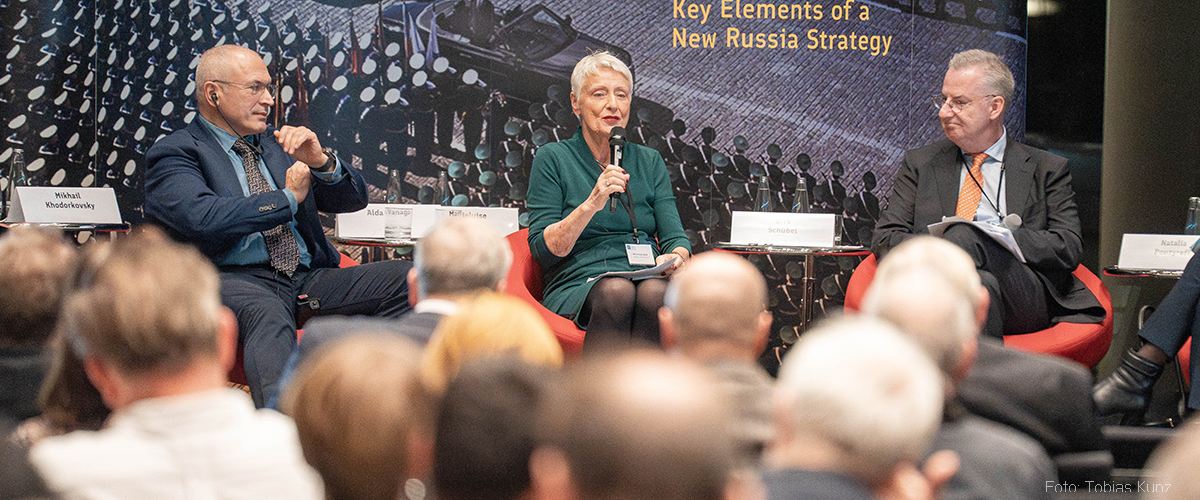
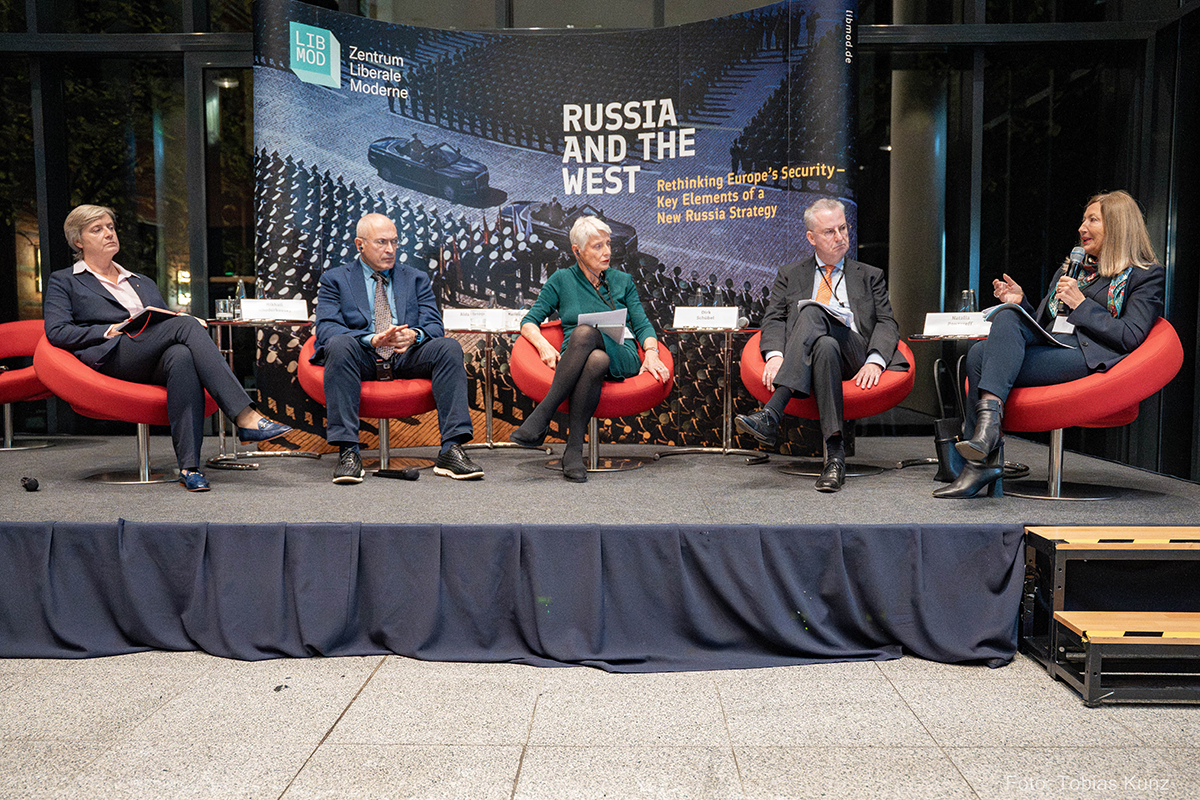
Russia is waging its full-scale war against Ukraine for four years already, but Germany and Europe are still struggling to find the right answers to the threat posed by Moscow. At this year’s panel discussion ‘Russia and the West’, participants called for deterrence and containment – but also for keeping contact with those in Russia who will be needed after the end of the regime.
The Putin regime will remain the greatest threat both to European security and to European democracy for the foreseeable future, LibMod-founder Ralf Fücks said in his opening remarks. Russia’s war against Ukraine is not just about territory, but also an expression of a systemic conflict between autocracy and democracy. And because Russia is supported by by authoritarian states such as Belarus, Iran, North Korea and China, a global alliance of democracies is needed to counter this.
During the ensuing discussion, the five panelists presented a series of proposals that would help Europe to succeed in this conflict. They also pointed to limitations of what is feasible.
‘The threat is long-term’
Latvian Ambassador Alda Vanaga emphasised that the threat from Russia is long-term: No end to the war is in sight, nor is change in Russia likely, even after the war does end. Therefore, Europe must unite against Moscow and invest heavily in defence. Latvia, she said, is well on its way to achieving NATO’s target of spending five per cent of its GDP on defence in 2026.
Vanaga added, that her country is capable and ready to defend NATO. She warned, however, that credible deterrence is lacking for the alliance as a whole.
A prerequisite for credible deterrence is that one’s own army is capable of waging war. French MP Natalie Pouzyreff addressed this issue by urgently calling for a reform of the European arms industry. She argued that national egoisms prevent the necessary consolidation of the industry. The goal must be to unify European armies and arms manufacturers. Only then will Europe be in a position to wage war.
Pouzyreff, who sits on the National Assembly’s Defence Committee, added that the defence industry secures jobs and promotes technology. It should be communicated clearly to the population that the supposedly distant war in Ukraine is ‘our war,’ in which European values such as freedom of expression and human rights are being defended. ‘We must not allow Russia to win,’ she demanded.
Europe ill-prepared
Polish expert Marcin Zaborowski said he himself was surprised at how ill-prepared Europe was for war: Not only is far too little ammunition being produced on the continent, but even in Poland, supposedly a model country that has achieved NATO’s 5 per cent target, there are major question marks regarding protective shelters and the number of hospitals.
Dirk Schübel, who heads the Russia department at the European External Action Service in Brussels, freely admitted that Europe had done too little in the past. Russia has been ‘hyperactive in recent months,’ flying drones not only over Poland, but also presumably over critical infrastructure and airports in various cities, which had to be closed as a result. In response, he called on Europe to strengthen its critical resources, such as cyber security and air defence.
Russian opposition politician Mikhail Khodorkovsky admitted that the damage caused by Kremlin propaganda in his country was considerable. He added that he had not expected state propaganda to be so successful and recalled that ‘in the Soviet Union, we just laughed at it’.
Contact with Russian society must be maintained, even if this society is deeply sick
Given that there will be no ‘de-Putinisation from above’ in Russia (like denazification in post-war Germany), the West should try at least to maintain contact with Russian society, even if these people have become ‘hostages of the regime’ and support it. “This means making an effort to distinguish between hostages and criminals and building relationships with the hostages, Khodorkovsky said. He added that this was necessary so that one day (when the dictatorship ends) Russian society would be open to contacts with Europe and to European values: ‘Contact with this society must be maintained, even if this society is deeply sick,’ he said.
LibMod co-founder Marieluise Beck, who moderated the discussion, agreed: While pro-regime elites should be isolated, it is necessary to keep contacts with those in Russia that will be needed one day –in order to lead their country out of darkness, she said.
Khodorkovsky also called for better communication from the West about the sanctions’ purpose. The issue, he said, was too often left to Kremlin propagandists. He also advocated for exchange programmes for Russian students.
Schübel noted that the EU’s Erasmus+ programme remains open to Russian students coming to Europe (however, the programme no longer supports European students going to Russia).
Hat Ihnen dieser Artikel gefallen? Wenn ja, können Sie die unabhängige redaktionelle Arbeit und den Journalismus von LibMod über ein einfaches Spendentool unterstützen.
Spenden über PayPal

Wir sind als gemeinnützige Organisation anerkannt, dementsprechend sind Spenden steuerlich absetzbar. Für eine Spendenbescheinigung (ab einem Betrag von 200 EUR erforderlich) senden Sie bitte Ihre Adressdaten an finanzen@libmod.de