
Lingen and the myth that Rosatom is irreplacable
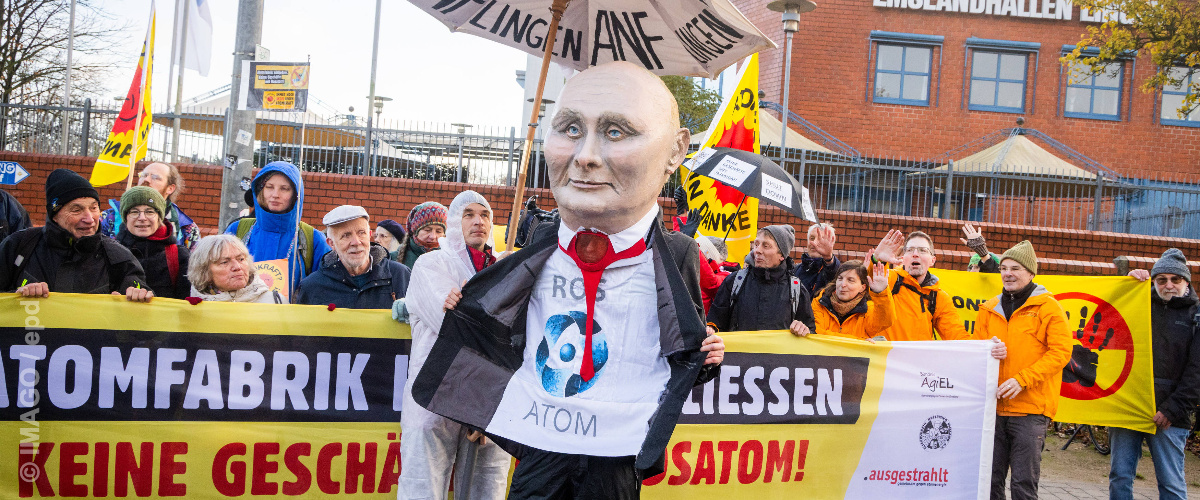
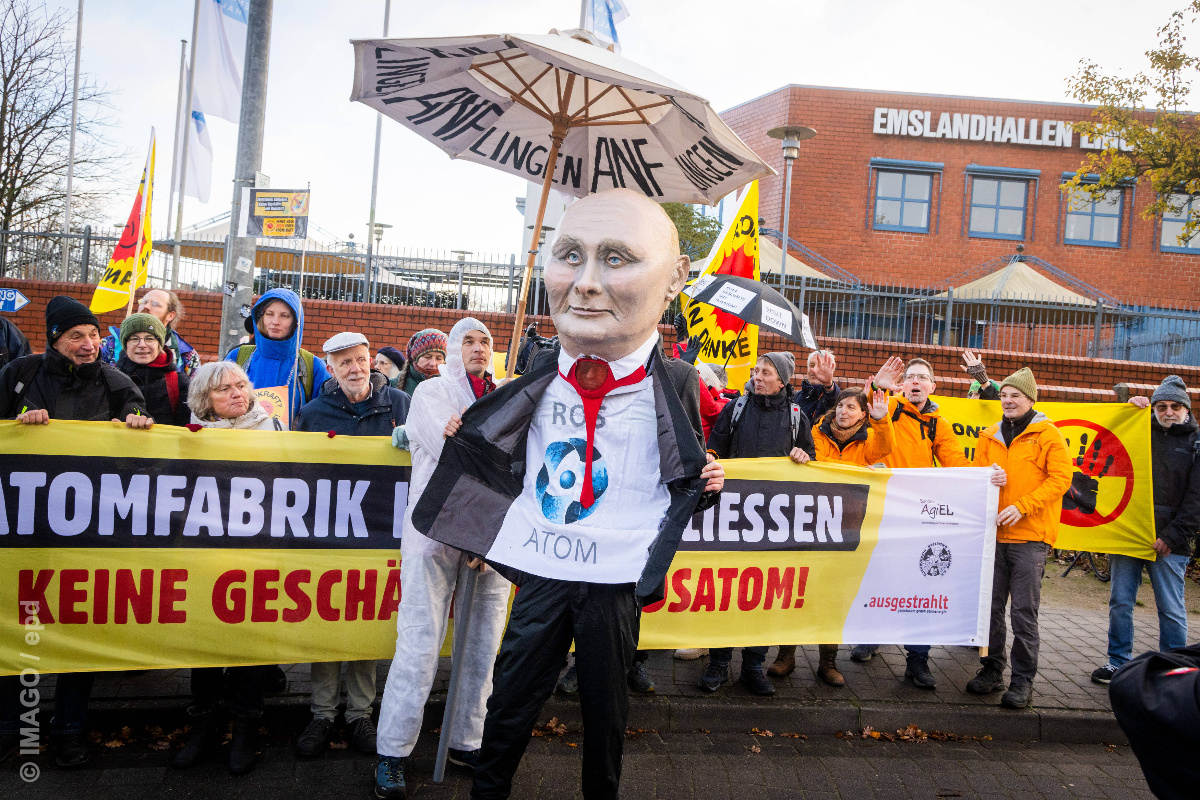
Already in 2024 protesters in Lingen carried a Putin effigy to demand the nuclear plant’s closure.
Despite serious security concerns, German authorities have approved a scheme that allows the production of Russian-engineered fuel rods in a nuclear energy plant in northern Germany. Their argument is that the Russian technology is irreplaceable. But experience from Ukraine tells a different story, argues Diana Sushkova.
On 22 July 2026, the authorities in the German state of Lower Saxony approved Advanced Nuclear Fuels’ (ANF), a subsidiary of Framatome, application to expand its fuel fabrication plant in the city of Lingen for the production of Soviet-designed hexagonal fuel assemblies (VVER fuel) under a licensing arrangement with TVEL, a subsidiary of Rosatom, Russia’s nuclear energy conglomerate.
The approved project provides for the production of VVER fuel assemblies expanding the existing Lingen plant using and integrating Russian licences, manufacturing know-how, machinery and components within the framework of Framatome’s cooperation with TVEL/Rosatom.
The project’s purpose is understandable. Today, 19 VVER reactors (VVER-440 and VVER-1000) are operating in the EU, including units in the Czech Republic, Finland, Hungary, Slovakia and Bulgaria. These reactors need specifically designed fuel assemblies which historically were supplied by Russia.
Russia’s full-scale invasion of Ukraine therefore created a real challenge for European nuclear operators: how to maintain security of fuel supply while reducing dependence on Russia. Framatome describes its approach as a two-track strategy. In the short term, it tries to manufacture fuel identical to the design already used in European VVER reactors; in parallel, it is developing its own European VVER fuel through the SAVE project which runs from July 2024 to June 2028, with a total budget of €18.68 million. The problem is that the first track does not eliminate Russian technological dependence. It relocates part of it to Germany.
Secure supplies — but at what cost?
The license was granted despite serious security risks related to internal and external security, espionage and sabotage, and the protection of critical infrastructure. Many of these concerns had already been raised during the licensing process, including the legal assessment by Gerhard Roller, a law professor at Bingen University.
The extensive additional security conditions established by the licence decision are the biggest proof that the risks are not only theoretical: TVEL-supplied IT/OT systems must be separated from the rest of the plant’s infrastructure; access to the Lingen plant for TVEL/Rosatom personnel is generally prohibited, while contacts with them must be limited to what is strictly necessary and conducted under the “four-eyes principle”; Russian-supplied control hardware and software must undergo independent checks, including source-code review; and all welded gadolinium fuel rods supplied by the Russian manufacturer MSZ must undergo 100% scanner inspection. In addition, as an alternative to analysing a fuel-pellet sample supplied by the manufacturer, one fuel rod may be unloaded on site and its fuel pellets independently analysed.
Recent incidents in Germany have made concerns about Russian sabotage and hybrid operations against European critical infrastructure even more realistic. On 1 September, the German government formally attributed the attempted explosive-drone attack at Leipzig/Halle Airport in August to Russia. German authorities said the evidence pointed clearly to Russian involvement.
Against this background Julia Verlinden, deputy leader of the Green parliamentary group in the Bundestag, is demanding a new safety assessment of the nuclear fuel production plant in Lingen. In addition, on 10 September, the environmentalist organization BUND, supported by the anti-nuclear organisation .ausgestrahlt, filed a lawsuit challenging the permit, arguing that the environmental assessment was incomplete and based on outdated documentation, that Rosatom’s involvement had not been fully disclosed in the application, and that Russian-supplied machinery creates risks of manipulation, espionage and sabotage.
The question therefore goes beyond whether individual risks can be mitigated by technical and administrative safeguards. If cooperation with a Russian state corporation itself generates additional security risks, Europe should also ask whether this technological dependence is necessary in the first place.
Rosatom is not irreplaceable
One argument which is frequently used by supporters of the Lingen project is that European VVER operators need a proven fuel solution and that replacing Russian nuclear fuel is technically difficult. This is true but it does not mean that Rosatom is irreplaceable.
Ukraine provides perhaps the clearest counterexample.
Westinghouse began developing an alternative fuel for Ukrainian VVER-1000 reactors more than two decades ago. The process was not easy and faced technical difficulties. Developing fuel compatible with Soviet-designed reactors required testing, design modifications and qualification. But those difficulties were resolved successfully. Ukraine subsequently expanded the use of Westinghouse fuel and moved away from Russian nuclear fuel supplies.
The more recent experience with VVER-440 reactors is even more instructive. Westinghouse and Energoatom accelerated development and licensing of an alternative VVER-440 fuel. The first reload batch was delivered and loaded at Ukraine’s Rivne Nuclear Power Plant in September 2023 after what Westinghouse described as a “record-setting development program”.
Three years later, Energoatom reported successful operation of its VVER-440 units with Westinghouse fuel. Today all Ukrainian nuclear power plants have switched to Westinghouse fuel for both VVER-1000 and VVER-440 reactors.
And Ukraine is no longer the only example. Finland’s Fortum loaded its first batch of Westinghouse fuel into the VVER-440 reactor at Loviisa in 2024 and continued loading it in 2025 and 2026.
Europe needs nuclear independence without Russia
There is another paradox in the Lingen project: Framatome itself is developing an alternative to Russian technology through the SAVE project. The EU is therefore funding the development of a sovereign European alternative to Russian VVER fuel, while a production model based on TVEL licences, know-how, machinery and components is being established inside the EU. Such a choice is particularly difficult to explain.
So the main question is what kind of security Europe wants to build — with Russia or without it.
Ukraine has already demonstrated that dependence on Russian nuclear fuel technology can be broken. Now it is time for Europe to show which path it will choose.
This article was prepared by DIXI Group with support of the International Renaissance Foundation within the framework of the project “Strengthening Ukraine’s Resilience in Energy”. It reflects the views of the authors and does not necessarily represent the position of the International Renaissance Foundation.
- Diana Sushkova is a Project Expert at the Ukrainian think tank DiXi Group, specializing in energy security and sanctions policy. Her work focuses on monitoring and assessing the effectiveness of energy sanctions against Russia, researching Russia’s oil, gas and nuclear sectors, and developing recommendations for strengthening sanctions. Her recent research has focused particularly on Rosatom, its international activities and links to Russia’s military-industrial complex.

Hat Ihnen unser Beitrag gefallen? Dann spenden Sie doch einfach und bequem über unser Spendentool. Sie unterstützen damit die publizistische Arbeit von LibMod. Wir sind als gemeinnützig anerkannt, entsprechend sind Spenden steuerlich absetzbar. Für eine Spendenbescheinigung (nötig bei einem Betrag über 200 EUR), senden Sie Ihre Adressdaten bitte an finanzen@libmod.de