
Putin wants all-encompassing internet censorship. Can he do it?
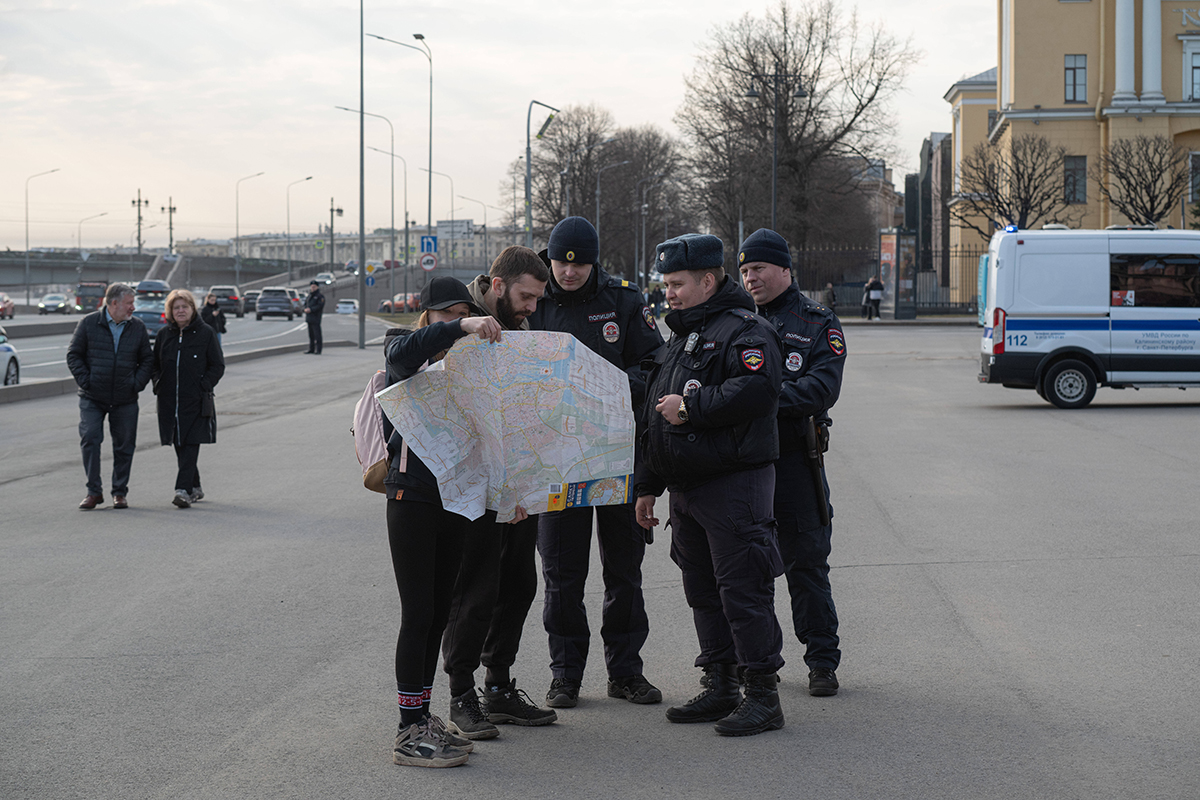
Police in St Petersburg speak to protesters holding up a paper map as a symbol for Russia’s internet outages.
The Russian regime is taking internet censorship to new levels. In numerous regions, including Moscow and St Petersburg, mobile internet was switched off completely this spring under the pretext of protection against drone attacks. Authorities have also begun blocking the popular Telegram app and stepped up their fight against virtual private networks (VPN), both of which allow accessing blocked online resources. How does Russian society respond?
The biggest mobile internet outage happened in early March, when central Moscow was cut off for almost three weeks, with serious consequences for the population and the economy. While previous cutoffs were explained by protection from drone strikes (Ukrainian long-range drones have used the Russian mobile network), that incident may have been a direct reaction to the February 28 U.S. and Israeli attack on Tehran, in which Ayatollah Ali Khamenei and other members of the Iranian leadership were killed.
Did Putin panic after Khamenei’s death?
Speculation that Putin had ordered the shutdown because he feared that he could suffer a similar fate as Khamenei was backed up by a later media report, which said that the Kremlin had ordered a special video surveillance service to be taken down out of security fears. The successful attack on Iran’s supreme leader was apparently made possible by hacked CCTV (closed-circuit television) data.
Temporary outages have continued, especially during the May 9 military parades, in which Russia commemorates the victory over Nazi Germany in 1945. Because of safety fears, this year’s main parade in Moscow was shrunk to a few foot soldiers without military hardware.
The shutdowns have widespread consequences for ordinary Russians’ daily lives – preventing the use of online maps, apps to order taxis and even the use of ATMs to withdraw cash.
And while most people in Russia have for years grown used to partial internet censorship, the situation has escalated this year. After virtually all foreign messaging services — WhatsApp, Signal and others — were blocked, the authorities began in the spring to throttle Telegram, the most important domestic provider, which also offers a route to reading lots of forbidden content. Instead, Russian users are being pressured to switch to the new state-approved Max messenger, which many people suspect of sharing personal data with the security services.
Censors step up fight against VPNs
But the state is also stepping up its campaign against the most important tool to bypass state censorship – “virtual private networks” (VPNs), which conceal users’ locations. In late March, the government apparently ordered national internet companies (retailers, banks and search engines) to block users detected to be using VPNs. And state censor Roskomnadzor reportedly intends to block more than 90 percent of VPN providers in Russia by 2030. Apple, which in 2024 admitted cooperation with Russian authorities, citing the risk that it might have to cease operations in Russia, has been busy removing VPN services from its App Store. As of June 16, the Apple Censorship project recorded 829 apps censored in the “Utilities” category, which includes VPN clients.
Even simple internet searches have become risky. A law that came into force last year makes it a criminal offense merely to search for content classified as “extremist.” In Russia, this potentially includes content related the LGBT movement, the rights of Indigenous people and ethnic minorities and the human rights organization Memorial.
Putin’s Paranoia
Behind all this apparently lies Putin’s deep-rooted paranoia toward the internet as a space for the free exchange of information. As early as 2014, the former KGB officer described the internet as a “CIA project.” The 73-year-old is known for using neither the internet nor mobile phones. At public appearances, Putin likes to read from handwritten notes — as he did during the online cabinet meeting on April 23, where he justified the internet restrictions as a measure against “terrorist threats.”
Russian media reports suggest that Putin has ordered control of the internet to be passed to his cronies at the Federal Security Service, or FSB, the Soviet KGB’s main successor agency. The exile outlet The Bell reported in April that the responsibility now lies with the FSB department responsible for fighting the opposition — officially, for the “protection of the constitutional order.”
The aim of the new internet policy is probably a whitelist system, in which all content is blocked by default and only state-approved services, ranging from news to banks and e‑commerce, remain accessible. The recent shutdowns were apparently also used to test this model in real life.
But have these growing restrictions created potential for protest? So far, the security forces seem to have largely suppressed meaningful public dissent. At the end of March, a group of young activists who went by the name “Red Swan” — Aly Lebed — was apparently successfully prevented from organizing nationwide protests against the blocking of Telegram.
More bizarre but also telling is the story of beauty blogger Victoria Bonya. In an Instagram reel published in April, the Monaco-based influencer claimed that Putin knew nothing about the internet blocks and ensuing hardships, because officials were hiding these problems from him After the video received millions of views on Instagram — a platform banned in Russia — Kremlin spokesman Dmitry Peskov publicly assured that the “issues” raised by Bonya were being worked on.
Putin’s approval problem
While a loyal blogger like Bonya, who touts the classic Russian narrative of the good Tsar being misinformed by nefarious boyars, poses little danger to the Kremlin, there is plenty of evidence that Putin’s approval ratings are falling. According to state pollster VTsIOM, they dropped from just under 80 percent at the beginning of the year to 65.6 percent at the end of April — although this figure was not published (and is still missing) on VTsIOM’s website.
The Levada Center, Russia’s only independent polling institute, most recently found a figure of 79 percent for April and May; in January it had still been 84 percent. Levada sociologists also recorded a sharp rise in uncertainty among the Russian population. The share of respondents who expressed a positive view of the country’s development fell from 67 percent in December to just 55 percent in April.
That trend also became visible among the Kremlin-controlled “systemic opposition.” While the ruling United Russia party’s ratings dropped below 30 per cent in April, the New People party — which can be described as mock liberal — shot up to more than 13 per cent, according to VTsIOM. Communist Party leader Gennady Zyuganov even warned of a new revolution in Russia.
Last hope: Total censorship technically impossible
Clearly, this change of mood has several causes. The Russian economy is feeling both the effects of Western sanctions, new taxes and the Kremlin-imposed priority for the arms industry. And as Ukraine succeeds in sending more and more drones farther into Russia, the war is moving deeper into the awareness of the population. Aggressive internet censorship has just added another source of pain.
Yet, although mobile internet has returned in places like Moscow and St Petersburg, it is clear that the new censorship regime is not going to go away soon. Some observers’ hopes that the restrictions will be eased once the “pragmatic camp” in the Kremlin gains the upper hand have not materialized – the pragmatists have ostensibly proven weaker than the siloviki, the hardliners in the security services. More importantly, though, the central decision-maker is and remains Putin, who has clearly decided that people in Russia should use only a “sovereign,” state-censored internet.
So will the internet-savvy Russian population just put up with this?
The biggest hope that remains is that a full implementation of Putin’s vision will be technically impossible. Many experts argue that the Russian internet cannot be completely censored because it has been allowed to expand uncensored and decentralized for too long.
Others point to the fact that in the cat-and-mouse game with state censors, the IT sector may ultimately retain the upper hand. A recent article by Deutsche Welle’s Russian service argued that the number of internet users in Russia is so large that it pays off for VPN providers to keep developing new loopholes to get around government blocks.
Hat Ihnen unser Beitrag gefallen? Dann spenden Sie doch einfach und bequem über unser Spendentool. Sie unterstützen damit die publizistische Arbeit von LibMod. Wir sind als gemeinnützig anerkannt, entsprechend sind Spenden steuerlich absetzbar. Für eine Spendenbescheinigung (nötig bei einem Betrag über 200 EUR), senden Sie Ihre Adressdaten bitte an finanzen@libmod.de